martedì 28 aprile 2015

Exploring Mindoro Island


Mindoro is one of the biggest island of the huge archipelago forming The Philippines and is relatively close to Manila, you just need a couple of hours to get to Batangas wharf and one more hour by boat.
I followed Leandro suggestion and stayed in Amami Resort, in Talipanan Beach.
In general I would not consider Mindoro, or better the tiny part of the island that I visited, as a Highlight, especially Porto Galera and White Beach which are very touristic places, often expensive and surely crowded with hawkers insisting in selling you some tours. However there are some nice places and spectacular waterfalls like Tamaraw Waterfalls, just on the main road near Porto Galera and the even more spectacular Tukuran Falls near San Teodoro village. Yet the part of the island between Porto Galera and San Teodoro is highly spectacular with scenic view of the ocean encased in a lush, green, rainforest.
I was told that the nicest and wildest part of Mindoro is on the south west coast which is a still undeveloped area, difficult to reach, difficult to travel because of gravel road full of potholes and crevices, very spectacular though.
Once you get to Sablayan, a slamm fishermen village, by boat you can reach the tiny Pandan Island where 30 years ago a frenchman settled a confortable but laidback resort. No wifi, no TV, I mean it's a lovely way to relax in a very secluded island and also to visit the near Apo reef which is also a spectacular and natural place to experience a wonderful excursion between sea and mountains.
I spent a very pleasant week in Amami resort (1500PHP per day) thanks to Fabio and his Pinoy mom, they are a perfect mixture between Pinoy courtesy and Italian exuberance, always helpful and friendly. Moreover, Max, their friend, cook, associate-manager prepared delicious meals (pasta, grilled fish, roasted potatoes, marvellous salads) and had a huge amount of patience to explain me Pinoy culture with its ups and detriments. He has been living in The Philippines for the last 6-8 years and he really knows how deep is the gap between western and Pinoy culture, from small cases to important stuff.


sabato 18 aprile 2015

Palawan: a secluded wonderful island


I heard so many friends talking about Palawan that it was my "duty" to go there and visit its famous places. Flying to Palawan is not cheap at all but being this island quite far, on the westsida of the Philippines archipelago, was the most convenient option.
Puerto Princesa is a boring, unappealing, chaotic city with some good restaurants, a few live-music clubs and a nice walkside on the Baywalk. It's nothing special but along the seaside there are some small food stalls, some shop sellers, lot of teenagers and families enjoying one of the few relaxing areas of PP.
I and my friend visited the famous underground river with its emerald green waters, its majestic wierd stalactites and stalagmites shaped in different ways (Holy Family, Jesus Christ face, corn-cob) and its unique microfauna living inside one of the few floating caves in the world. It was a nice experience the friendly tour guide seemed to repeat a "lesson" learned with the huge amount of touristis crowding this place but for sure it's a kind of exaggeration saying that this site belongs to the new list of the most beautiful places in the world. In Italy we have too many caves (Frasassi, Postumia)that are not less spectacular.
After a long and tiring trip we arrived to the famous El Nido, a tiny, crowded, now touristic village who was born as a fishing village and as a place for "harvesting"the sparrow nests (El Nido means The Chest in spanish). This strange and dangerous activity is quite famous alla around asia: some brave locals use long and tall bamboo ladders to grasps these chests made by regurgitating sparrow saliva, and this very expensive saliva is considered a very good and natural medicin for many diseases other than a skin tonic.
However the last 10-15 years this place underwent the assault of mass tourism thanks to the amazing beaches, the pristine waters and it's natural and unique bays. North Europeans, Australians, Americans and, during Easter time, Pilipinos throng this places and as a result everything costs between 30 and 50% more than in the other regions of The Philippines (except Boracay).
Excursions, especially A and C, takes you with about 20 US dollars to marvellous islands, amazing coral reefs, incredibles hidden coves, stunning small churches and super snorkeling spots.
Once in your life you have to come here but a second time, in my opinion, unless you rent or owns a sailboat that will allow you explore many other spots, I will not return and prefer explore one of the many other natural jewells of this country.


lunedì 13 aprile 2015

Manila: an awful metropolis


When you get to a huge asian metropolis you rarely expect to find a nice place. It's quite normal to get into a nightmare place made of pollution, confusion, traffic jam, pick pokets and expensive prices.
However I recognize that Jakarta has a vibrant nightlife and convenient priced hotels (traffic jam is unbearable though), Bangkok has a marvellous collection of temples, a lovely Chinatown with delicious streetfood and an charming system of cheap waterways...what about Manila???
Manila, on the other side, has very little to catch the interest of a visitor, I might be wrong, maybe expats living there got accustomed and like it, maybe you need some time to discover its hidden "treasures", however I spent as little time as possible there visiting a few places.
The airport is in a total permanent mess: lost baggage is a regular affair, long rows of angry passengers, delays and cancellation of flights, timetables shown only 30 minutes before the supposed time of departure.
Quezon city is not too bad, has some interesting nightlife on the Tomas Morato with many clubs and bars, it's far from the airport but well connected by the MRT.
Malate some years ago was the red light area of Manila but now is a quiet, area with some small restaurants and an ugly seaside populated by the longest row of clochard I have ever found. I didn't feel in any kind of dangers, they just seemed very poor people, sometimes entire family, often earning little money giving massage. There I and my friend met some nice teenagers listening to good music and keen to chat with us.
Pasay city is a very crowded area conveniently located at 15min from the International departure, it's not too far from the Farmer market and has small alleyways which reminded me Vietnam, nothing special but small food stalls and some friendly people which make it an interesting overlooked part of this metropolis.
Rizal Park has not the beauty nor the charme of Lumpini Park in Bangkok, but it's a lovely way to escape the crowd and the pollution of Manila. It has a small lake, several statues of the national hero J.Rizal and a beautiful Chinese park very relaxing with its Chinese red lantern and cute paths.
Makati is the downtown, the business district, the expensive, clean and false face of Manila, just the opposite of the many shanty town were poor people are obliged to live.


mercoledì 8 aprile 2015

Travelling Somewhere New


November 2014, just returned from my marvellous 3 weeks travel from Indonesia and, since Ebola was scaring my parents and brothers, I skipped west Africa and planned next trip to The Philippines.
I had lot of tiny silly doubts about this country because some friends and acquaintances reported the Phlippines, the only catholic country in Asia, as a place where you should be "careful"of thieves and criminality in general.
As I said many times, most of us, if not all, are afraid of whatever is NEW, we fear any type of change, from food (Italians become mad when they cannot find a good plate of pasta..)to people, from habits to language. Once you find enough courage to get there, you discover how EXCITING is everything you find, how tasty is every kind of food you eat, how nice and lovely and friendly locals are, especially those curious to talk with you. Yet you realize that no suggestion, no tip, no book, no friend can predict what your feelings will be once you get somewhere new, this kind of exciting mistery, this small big rick is the main reason you should give a try.
I did it and, thanks God, loved the Philippines after a 10 days of confusion and dizziness.

sabato 3 gennaio 2015

the way I experienced Indonesia


Just one day before my next trip to The Philippines I have finished to read the brillant, funny and interesting book of Elizabeth Pisani, Indonesia etc. and I would like to write a short essay from her epilogue because it matches so much with my 3 weeks travel experience:
"Like all Bad Boyfriends, Indonesia certainly has its downsides. The staff in the tourist office are spectacularly incompetent, it's true (and also utterly charming). The cops will try and shake you down every now and then, without doubt (but they will also steal your bike back when you lose the key, and drive you to the locksmith into the bargain). The government makes a habit of announcing  cataclysmic political changes with a minimum of preparation, certainly. But Indonesia's upsides, the openness, the pragmatism, the generosity of its people, their relaxed attitude to life, are ultimately the more seductive traits, and the more important."
No way to say that I should also thank all the Indonesians we met in our route for their kindness, friendship and generosity.


mercoledì 31 dicembre 2014

relaxing on the beach of Selayar island


While planning this 3 weeks in Indonesia my first idea was to spend a few days relaxing in a beautful Indonesian beach. The first problem was to localize one of the thousand lovely places which could be reached in a reasonable time and at a reasonable cost, immediately. looking at the map I thought about Sulawesi, this huge island with the shape of a beast. Around it there are too many islands like Togean, Bunaken (near Manado), Sangihe and many more but we opted for kepulauan Wakatobi. Pity that a few days before we discovered that all the little accommodation (no more than 50 places available actually) of Wakatobi had already been booked by a group of Koreans thus we decided to spend our 3 days in the near Selayar island. The second problem was to find a good, reliable, sturdy, experienced travel companion who could speak a decent bahasa and could bear my sometimes heavy and childish behaviour not to mention my nosy attitude toward any aspect of a new country and culture.
No need to say that Ibu Galuh was definitively my first choice given all her travel tales with her friends in every corner of Java and in even basic accommodation.
Thanks to my good luck she was able to take a one week vacation and work for free as  my personal travel guide.
We arrived in Makassar, a huge, polluted, extremely hot city and got a nice comfortable hotel not far from the marina area. In the weekend there were some festivals with foodstalls, live music and lot of locals enjoying the festival despite the usual motorbike jungle and the lack of sidewalks.
Galuh got phone number of local guides arranging a rented car with driver(700KIDR) who took us from Makassar to the  easternmost coastal tip of the left "leg" of Sulawesi island, travelling around lovely rice paddies, green emerald fields and already harvested ones gold coloured, coconut trees and water basins used to produce salt until we got to the ferry dock toward Selayar island.
We arrived on the late afternoon in the island and I immediately loved it's silence, dark and quiet atmosphere totally opposite to the chaotic traffic and noise of Makassar.
I can't remember the name of the ugly and shabby hotel with its ridiculous uninspiring breakfast BUT  our lovely guidetook us to the small Oriente restaurant which served delicious homemade food whith a huge choice of fish, noodles, vegetables and soups in a very relaxing atmosphere. We loved this place! The following morning we bought some food at a local Padang (Elizabeth Pisani describes this food as the In donesian McDonald for its ubiquity thanks to the Sumatra tribe which travelled all around this huge country) and by a typical 2 stranded roofed pirogue we cruised toward the marvellous Liang Kereta Beach with its white soft sand and pristing, emerald, phenomenal, enticing water. By the time the boat landed on the beach we took thousands photos of this magnificent cove I immediately took fins and snorkel and hurried in the warm water, the reef was nice but not super, I mean not so many fishes and not too many colors.
Once returned on the island we visited an ancient hamlet with old cosy wooden houses built on stealts, some of them lovely painted, all of them with lot of flowers, little friendly dogs and nice smiling dwellers then we have been shown some old big cannons, a huge metal bell.
I's a pity we could not visit other beautiful island b ut it was anyway a great relaxing experience!


giovedì 18 dicembre 2014

Tana Toraja: The City of Deads


Before talking with Galuh I knew very little about Tana Toraja. I thought it was just a place where  a strong and sour high quality Arabica Coffee (its cultivation was first introduced 50 years ago by the Japaneses) cultivated as well as a couple of delicious types of rice , a red and a black one. The second one, in the ancient times, was produced in tiny amounts just for high rank religious, governors and politicians (I bought both of them by the way).
As the bus arrived in Toraja, a local guide, Adrian, "grabbed" us, took us to the near, central and comfortable Indra Toraja Hotel (480K IDR per day) and offered us a 2 days tour which costed, after a long bargain, 1300K IDR plus 150K IDR for some cigarettes as a present to the chief of the local tribe.
Toraja has a mild climate thanks to its location on a hill and lies 70km to the sea and has a population of 1 million inhabitants, mostly Protestant Catholic (considering all Sulawesi island, muslims are prevalent only in Makassar), religion brought by the Dutch colonizers.
Later on I discovered that the main feature of Toraja, the one which makes it famous all around the world, is its Funeral Ceremonies. We were very lucky to get there during one of this ceremony.
The siblings of the dead spend all their life collecting all the money they can for these huge and expensive ceremonies and sometimes they need to keep the corpse on their homes (the body get a formalin injection) while saving this money.
The best ceremonies are those organized by middle and upper-class families (the poors are commonly intrred) and often take place on december during Christmas time. All the siblings organize music, dances, buffalo fightings, eat together plenty of food even for the not infrequent foreigner visitors, a big number of poor pigs (crying and shouting desperately) and buffaloes are slaughtered and immediately grilled and served.
There is a general climate of happiness, smiles and curiousity by the families and friends of the dead relatives, no problem i taking photos and eating some local dish with them.
Our guide said that in the ancient times someone was able to make the dead do little works like a zombie just performing special magical prayers...who knows it really happened????
The coffin is then put inside a handcarved grave (a mountain side or, like on the slopes of the anciently erupted blouders around Mentirotiku Batutumonga dormant Volcano), grave that needs the hard work of 2 men who spend on this task 1 or more years.
Along with the graves there are also some wooden made puppets reproducing the dead. The families bring on their shoulders the coffin climbing until 10 or 20 meters using bamboo stairs, and a variant of it requires, instead of the puppets, huge rock pillars, also handcarved, that are transported by the relatives until the field that works like a cemetery. here too we can see small pillars that represent dead kids, the medium ones are for dead women while the tallest ones are reserved for men or important people. The tallest the pillar or the more buffaloes are sacrificed (the Albino buffaloes cost a fortune!) or in other words the more important the dead and the more expensive should be.
Just to give you a clue, it's like if a guy who earns 500US$ a month would save enough money to pay a 500.000 US$ worth funeral ceremony...just imagine that someone so desperate about this scaring future scenario prefers to change religion!
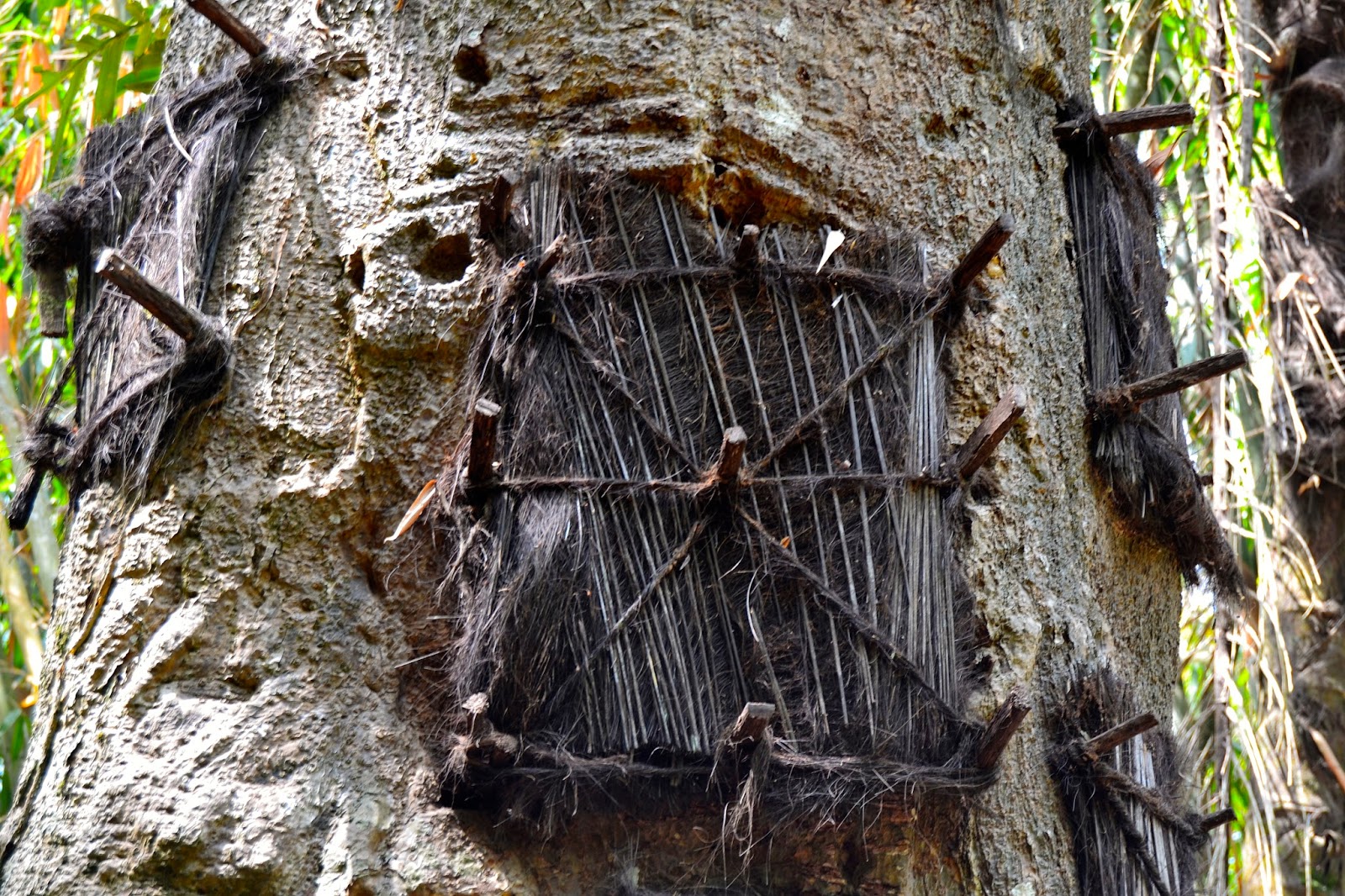
Last but not least we were just amazed by the way they use to bury the small babies (when they die and have not teeth yet which means they are still pure): during the night the baby family bring the tiny corpse in the countryside and dig a hole inside the trunk of a Tarra tree, put inside the body in a standing position (to help the baby sould to fly faster toward the heaven) and cover it with a fiber palm tree using its releasing material (kulimbang fibers). They live it until the tree absorb compltely the small corpse releasing all the fibers and leaving just some light "scars" on the trunk. You can use the same location on the trunk just once, we visited a famous huge
300 years old Tarra tree, no more used, which assimilated tens old baby's body in it. This tree is located in Kampung Kambira Kambira, Sangalla District, about 20 km from the town of Rantepao.
For sure Tana Toraja was one of the highlight of my trip and a place to be visited at least once in your life!